Sunday, January 6, 2019

Iceland's Waterfalls, Hot Springs and Ice

     There's no shortage of water in Iceland. Everywhere my sister and I traveled (almost two weeks in August 2018), every mile along the coast and interior Iceland, water is crashing, falling, melting, freezing and moving. 


      Millions of years of a changing landscape because of water. This five-hundred plus foot cliff (below photo) is along Iceland's western coast where birds nest and roost.


     In the photo above, for perspective, there are hundreds of terns nesting on the cliff wall and two humans walking along the cliff (below photo zooms to show the detail). 


Picturesque calm bay . . .


     Some waterfalls were humongous; the red-roof home on the left side offers some perspective.


     Here's a better shot of that same waterfall known as the Skogafoss, falling almost 200 feet. See the tourists walking up the path (reportedly 527 steps) on the right side to the lookout point at the top?


Waterfalls everywhere!


Someone built stone corrals along this little waterfall . . . 
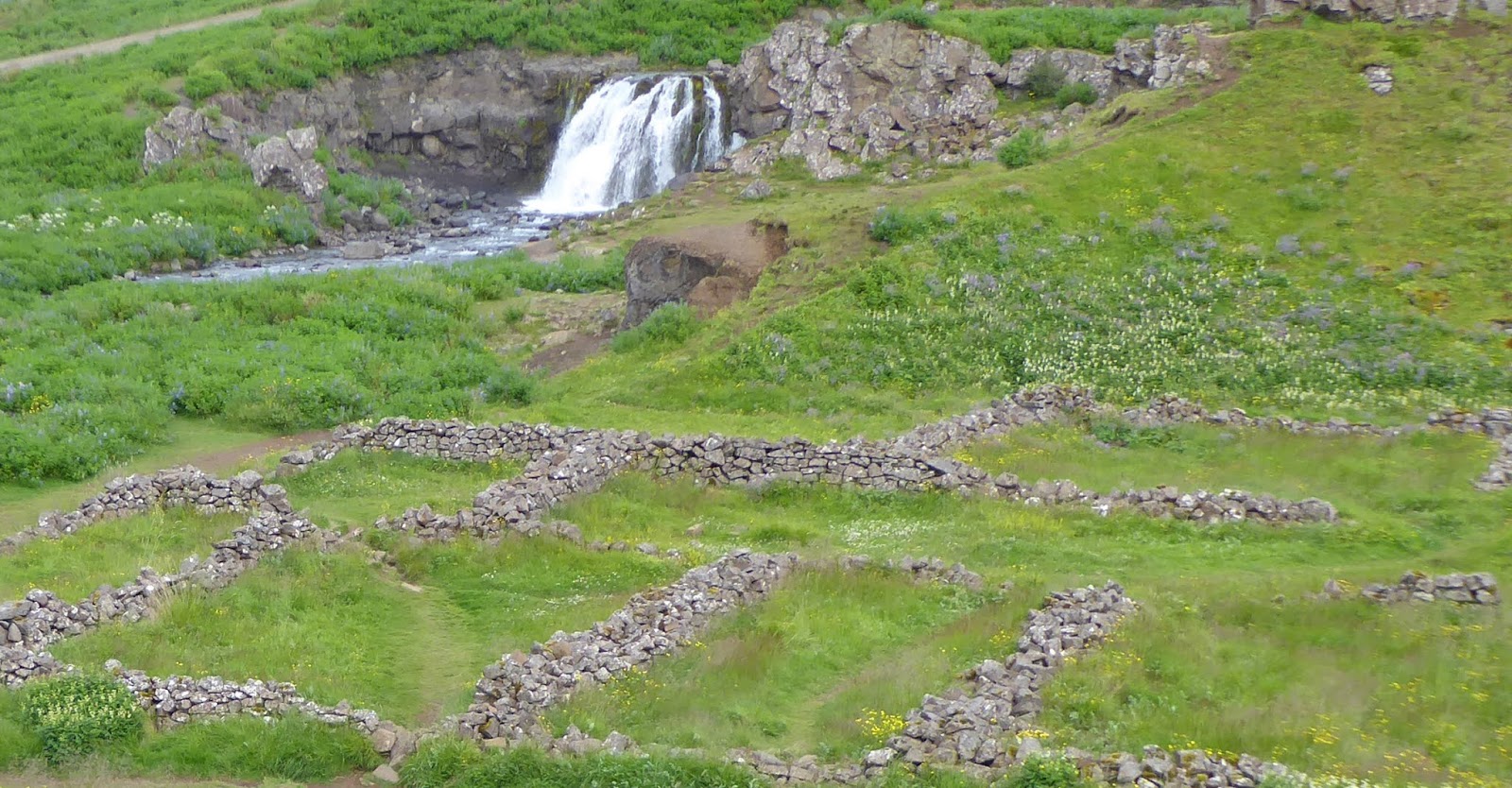

Every waterfall is a little bit different . . 

Doesn't it look like a waterfall coming from nowhere? See the tourists?


     The enjoyable part of visiting a waterfall, for me, is looking UP at the waterfall, not climbing to the top to look down.


Just your everyday waterfall along a road somewhere; see both of them?


Big fat waterfalls and skinny elongated waterfalls.


     Can't remember where this waterfall was, but it was obviously along the paved Ring Road. See all the parked cars and the crowd of tourists at the foot of the falls?


     In fact, we got tired of waterfalls and eventually didn't stop, passing on by just like a local.


This waterfall (below) however was out of this world stunning! See the tourists on the left side walking to the lookout point?


     The hike to this waterfall (below) was fun. It's a world heritage site; where a rift valley is formed between the North American and Eurasian tectonic plates. More about that in another post.


Ho hum, another waterfall . . . .


Same waterfall below? Nope, different one!


They also use hot water to generate electricity and to keep greenhouses operating year-round.


The greenhouses are fascinating. Very little soil and almost everything is automated.


Each plant's roots are submerged in a miniscule amount of soil that gets drip-water on a schedule. High tech vegetables!


     Those skinny green stems (photo above) each go to a tiny pot of soil, about 2" by 2". This is a cucumber greenhouse. The next greenhouse will be tomatoes, etc. 
     Only one percent of Iceland's land is agriculturally used, and grass (hay, cut and rolled in colorful plastic bags) is the primary "crop".


     There are also several dairy farms heated by geothermal waters. This dairy barn at Flatey houses about 550 cows and calves.


     Inside, everything is automated.


     Milking is automated too. The cows with ID neckbands walk over to the robotic milking machine (big red contraption in front) which eyeballs the teats and cleans them before attaching; data on time and milk volume is recorded for each cow. We witnessed a couple of skirmishes (hey! no butting in line, go to the back! Mabel said to Ethel) but mostly they calmly wait in line for their turn at these machines. Very little interaction with humans.


The calves are kept separate from the time they're born.


There were signs describing the entire dairy operation with a cat-walk for tourists in a loft area.


     We also saw a couple of barn cats strolling and napping in the barn. And we were amazed to see a couple robotic pooper scoopers.


     They had a pre-designed route throughout the barn; the floor was relatively clean considering all those cows. They moved very slowly so as not to scare the cows.


     Photo above is one of Iceland's geysers which didn't blow while I waited with a camera and then when I tired of waiting and put my camera away, it blew up quickly and briefly.


Hot pools are usually too hot for humans (212 degrees Fahrenheit).


      Photo above is the less famous "Secret Lagoon" which is more natural and intimate than the famed Blue Lagoon where thousands of tourists arrive in hordes of busses paying outlandish prices. See my happy sister, center of photo?
         
     I much preferred swimming laps in a heated swimming pool. Almost every village has a "sundlaug" either indoors or outdoors; photo below is the village of Vik's pool which overlooks the seashore, mountains and glaciers. How lucky can a lap swimmer get? Yes it was cold getting out, but nearby was a hot tub.


We joined a small group of kayakers one day.


     It took an hour for our small group to get fitted in dry suits, gloves, boots and vests.


Ice grips on our boots were a MUST.


     It was a bit treacherous, walking around to view the special places. One wrong slip and bye-bye! The guide was very knowledgeable. 


     Paddling a double-seated kayak with my sister was fun (photo below isn't us, but we took our turn there). 


That's me (below photo) in the front. Notice how silty the water is? Glacial waters mix with black volcanic ash.
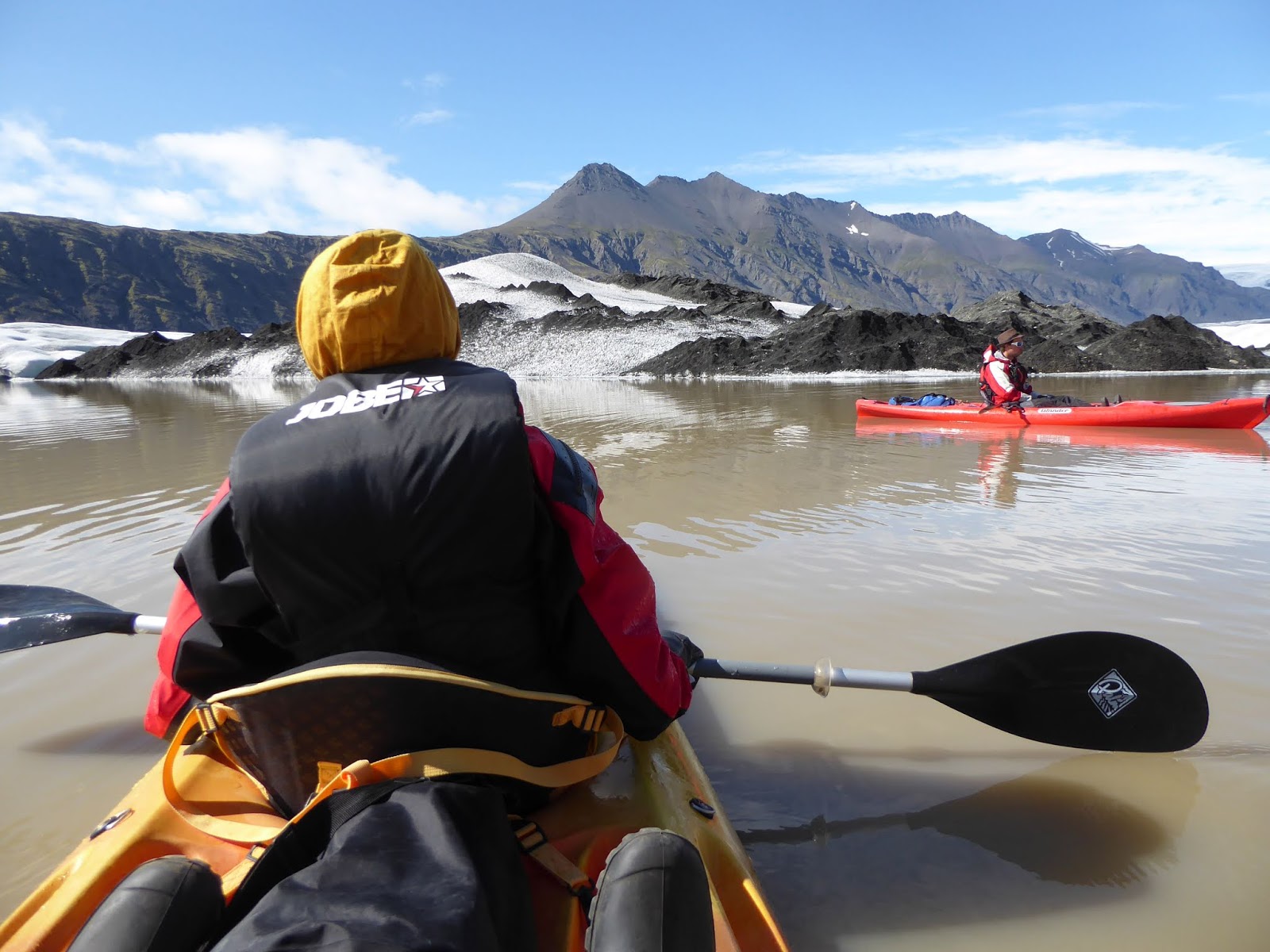


     The tricky part of paddling around mini-icebergs (unknownst to me at the time) is that they move continually.


    So if we found a passage way to a certain point, chances are high we wouldn't be able to return on that same passage way, because the mini-icebergs merge and separate continually, slowly but surely.


     I hadn't realized going-into this wonderful adventure how beautiful shiny sculptured ice could be . . .


It was fortunately a beautiful day for paddling.


Slow moving icebergs . . .


      Below is our guide pushing a mini-iceberg over to make a passage way out for us. If there's no passage way, we'd have to lug and walk our kayaks on treacherous larger icebergs. And climbing an iceberg to get a view of a potential passage way is treacherous too. 


     Below photo is the cute little fishing village of Husavik, population 2,182 which is known for its wooden church (center of photo) built in 1907. 


This is the interior of that cute wooden church.


     Husavik is also known for its whale watching business. Whales of different species visit Husavik's warm bay annually.


We got lucky with a sighting of a humpback whale.


Same whale below . . . see the large white front flipper just under the surface?


Next post, I'll mention Iceland's unique weather-durable architecture.


Saturday, January 5, 2019

Iceland's Ring Road

     Five months ago, my sister Vicki and I flew to Iceland and rented a diesel 4x4 Duster with a tent on top. 


     Besides driving on the paved major road known as the "Ring Road", we traveled on gravel roads where 4x4 was legally required.


     To be on the safe side, we purchased an expensive rider on our rental auto insurance for gravel damage. The best time to have a gravel road all to ourselves was between 6 and 10 am.      


     Fuel stations provide free water hoses to keep vehicles clean because muddy gravel roads are common everywhere.  


     We're both athletic, independent and adventuresome, so the tent on top was an ideal choice for us to explore Iceland for 12 days -- campgrounds were usually wonderfully scenic and also much cheaper than hotels. There was usually a scenic spot designated for tenters while those of us in a campervan or motorhome were put in a parking lot.


      Some campgrounds were packed with campers, but others like the one in below photo, had plenty of space.


     We traveled the "Ring Road" mostly, but we made a few excursions off the major roads on gravel roads. This was our route for 12 days.


     Iceland is "awesome" and "magical". Yes I know they're over-used words so I'll let these photos explain my captivation with this wonderful little island country. Some are my photos, some are my sister's.

     Iceland is "in-your-face" green and mountainous! See the little barn lower left? 


See the sod-covered barn and the steel barn to its left?


     Lots of green pastures for the Icelandic horse. 


     And lots of grass cut and rolled in colorful bales for sheep, cows and horses during the long winter months.


     We drove by many pastures with more than 100 horses. When I asked a local horseman how any rancher could care for 100 horses (hooves, hay, teeth, vet bills, etc.) he explained matter-of-factly that Iceland had slaughtered many of its 70,000 horses for Russia's meat consumption before its' trade ban three years ago. Yes, my sister and I were shocked; one blemish on this country.
     

     But not everything was green, there were dreary cold rainy days when everything looked black and white.


      Despite being August, it was cold, wet and windy most days. We slept in our clothes; sunrise was about 5 AM and sunset was about 10 PM. We were usually quickly on the road (heat!!!) by 6 AM.


The reason I like this photo (above) is all the little red steel roofs on the lower right of photo in the setting sunlight (below is a close-up of the same photo).


                  Spectacular views at many campgrounds . . . perfect weather for many rainbows.


And spectacular off-road adventures; that's me in photo lower right near the cavern opening.


Another photo of the same area which was near the southern coast.


                                Black lava fields . . . 


Iceland's flora is similar to Greenland and Scotland, plenty of fungi and alga. 


Fungi and alga covered lava fields account for the majority of Iceland's flora.


We saw millions of "cottongrass" blooms. It should be the national flower but Iceland thinks a national flower is silly.


Many farms are built against a mountain . . . 


Wonderfully isolated places to hike; that's my sister in photos below.


We walked at least a couple miles every day . . . 


. . . walking in good and bad weather. 


There was always a beautiful place to take a walk for a couple of hours.


Fortunately, the tourist busses were too big to park near these beautiful places.


     This was an exceptionally nice sunset at a campground.


The Hverir is a special place too.


     Steam plumes, solfataren, fumaroles and boiling mud pots.


Pastel-colored . . . 


And glacial tongues galore!


     We ventured out on a lake with mini-icebergs with a group of kayakers -- photos coming next post.


     This seashore (photo below) is near the little town of Vik; those iconic spiral rock towers (lower left) are known as Reynisdrangar rock formations. 


      Here's a close-up shot of those iconic towers of rock.


     We drove up a gravel road (photo below) and then hiked up to the top of a mountain overlooking those iconic towers in the sea. 


     We were rewarded for that rainy wet cold windy hike! The puffins were hunkered down on a cliff in the bad weather, offering us a close-up view.


     We returned to Iceland mid-November on our flight home to the USA from our Eastern European adventures, spending three days in Reykjavik and staying at a hostel. We walked around the big town (doesn't fit the city-category) amidst the foggy weather; daylight hours were very short, windy, cold, rainy. Saw the former British consulate building . . .


. . . where Reagan and Gorbachev held their October 1986 meeting about a number of issues; nothing was resolved at the time. I suspect Reagan was warming up his Russian counterpart to a larger plan (his famous speech at Berlin nine months later).


This time around in Iceland, daylight hours were very short - sunrise was 10 AM and sunset was 4 PM.  We were hoping to see Northern Lights. But, unfortunately the atmosphere and weather weren't conducive to Northern Lights. Plan B was a very informative visit to the Northern Lights Center in the city where we took this fun photo of ourselves. The exhibits and film are outstanding, worth the $12 USD entrance fee. The scariest part was learning about the solar storm of 1859 and how another storm like that one could devastate our technology-based livelihood.


    By the way, I didn't predict a language problem. I had assumed groceries and road signs would be bilingual (English and Icelandic). But we were on our own at grocery stores and other places to figure out what the labels and signs said. Many younger tourists had instant translation on their smartphones, which we didn't have. The Icelandic language bears no resemblance to the Romance languages, it's long on consonants and short on vowels.


      But most Icelandic folks can converse a bit in English more so than we Americans can converse in Icelandic. Did you know that the Icelandics believe in elves? I met one :)


And my sister befriended an unhappy ogre.


More Iceland stories coming up in my next post . . . this post is just the tip of the iceberg :)